
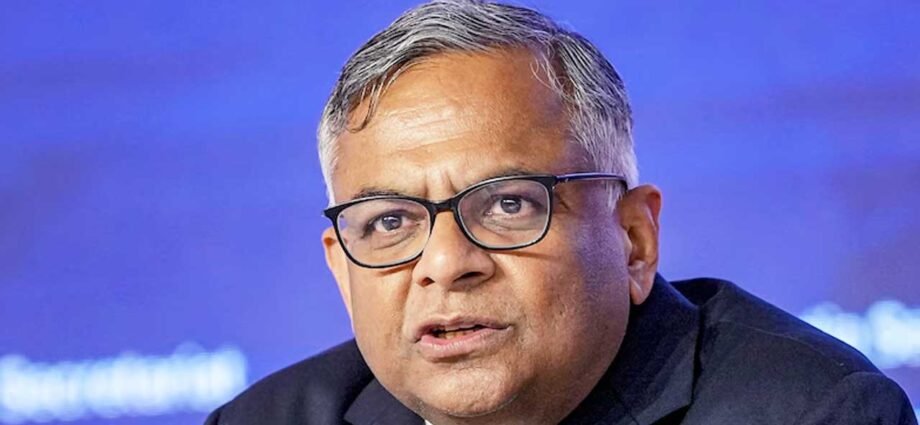
Mumbai, Aug 12, 2026 — For months, insiders had seen this coming. Now, just days before a shareholder meeting that could have turned contentious, Natarajan Chandrasekaran has confirmed he will not continue as chairman of Tata Sons beyond his present term — closing out a run that reshaped one of India’s most storied business houses.
Chandrasekaran, who goes by “Chandra” within Tata circles, made the announcement on Wednesday, ahead of the group’s August 18 annual general meeting. He is not quitting outright — he intends to finish out his term, which runs until February 20, 2027 — but he has ruled himself out of contention for another stint at the top.
A Standoff That Simmered for Half a Year
The writing had been on the wall since February, when the Tata Sons board failed to reach agreement on renewing his mandate, reportedly amid internal disagreement over the performance of certain group businesses. In his own words, Chandrasekaran noted that half a year had gone by since the board first took up his reappointment, with no resolution in sight even now.
Rather than let the uncertainty drag on, he chose to step aside voluntarily, urging directors to identify his replacement without delay so that the transition could happen cleanly. His reasoning: with several group-wide initiatives at pivotal moments, employees, shareholders and business partners alike need clarity about who is steering the ship.
Nearly Four Decades, One Employer
Chandrasekaran’s Tata journey began long before he ever sat in the chairman’s seat. He joined the group in 1987 as a young recruit at Tata Consultancy Services, climbing steadily over roughly thirty years until he became TCS’s Managing Director and CEO in 2009. It was from that perch that he oversaw TCS’s rise into India’s biggest private employer and its single most valuable listed company.
His elevation to group chairman in 2017 came at a turbulent moment for Tata Sons, arriving in the wake of the very public falling-out that removed Cyrus Mistry from the same post. Chandrasekaran was, notably, the first outsider to lead the conglomerate without any blood ties to the Tata family.
Under his stewardship, the empire expanded well beyond its traditional strongholds — pushing hard into semiconductors, electronics manufacturing, aviation and next-generation technology — and now spans 31 companies with a footprint in over 100 nations.
Turbulence in the Skies, Pressure in the Server Rooms
Not everything in Chandrasekaran’s tenure went smoothly. TCS, long the group’s cash engine, has been buffeted by weaker global IT spending and the disruptive rise of generative AI, with its stock shedding more than a fifth of its value over the last twelve months. Addressing shareholders at TCS’s AGM last month, Chandrasekaran struck an optimistic note, suggesting the company could soon deploy nearly as many AI agents as it has human staff, and describing artificial intelligence as an opening for enterprise technology rather than a danger to it. He pointed to resilient margins, growing revenue, and a robust order pipeline as reasons for confidence.
Air India, the national carrier Tata reclaimed from government control in 2022, has proven a tougher turnaround story. Efforts to fold smaller airlines into the Air India brand and overhaul its operations have been repeatedly overshadowed by crisis. The lowest point came in June 2025, when an Ahmedabad-to-London flight went down moments after takeoff, killing 241 of 242 people aboard plus 19 on the ground. In a more recent episode, a flight from Phuket to Delhi suffered a sudden loss of altitude that injured passengers, and the pilot at the controls reportedly tested positive for marijuana use in a follow-up drug screening.
Adding to the strain, the broader Tata empire has also had to weather a cyberattack that disrupted Jaguar Land Rover, even as competitive pressure mounts across its technology division.
The Farm Boy Behind the Corner Office
Long before boardrooms and billion-dollar deals, Chandrasekaran was a child of rural Tamil Nadu, raised on a roughly 15-acre family farm where sugarcane, rice and bananas were the crops of choice. Reflecting on those years in a 2015 conversation with the New York Times, he described his father as the man who taught him to respect “the value of everything you get” — a discipline around accountability that, he said, eventually became instinctive.
His father had once hoped a son would return to run the farm, and Chandrasekaran gave it a try after earning a science degree — only to find, after a few restless months, that it wasn’t for him. He pivoted instead toward a master’s in computer science, setting him on the path to Tata.
He has also spoken warmly of his mother, whose days reportedly stretched from four in the morning to ten at night, calling her work ethic a source of inspiration for all her children. His own early leadership instincts showed up in smaller arenas too — as class leader and badminton captain at school — experiences that, he has said, shaped his belief that real learning comes from culture rather than top-down mandates, and that hiring should prioritise passion and teamwork over pedigree.
Honours Along the Way
Chandrasekaran’s contributions to Indian industry earned him the Padma Bhushan in 2022, one of the country’s highest civilian distinctions. France has also recognised him with the Legion d’Honneur for deepening economic ties between the two countries. Outside the boardroom, he authored Bridgital Nation, a book exploring how technology could help close India’s development gaps, and has picked up honorary doctorates from institutions including Macquarie University in Australia, Nyenrode University in the Netherlands, and the Regional Engineering College in Trichy, Tamil Nadu.