
Yoga has been practised in India for thousands of years, but nowadays it is practised in homes and studios around the globe. What was once a religious practice has become one of the most widely embraced methods of enhancing physical and mental well-being. With so many different styles, intensities, and schools of thought, one question always appears to arise: how long should a yoga session be?
The reality, however, is that there is no one definitive solution. The optimal length and frequency of yoga are determined by where you are on your path, what your intentions are, and how much time you can realistically spend on your practice. Ten minutes of conscious stretching might be just the rebooting tool for some, but for others, a ninety-minute flow is the culmination of their day.
The ideal duration for a yoga session varies based on your fitness level, goals, and available time. While common practices range from 20 to 90 minutes, consistency often outweighs the length of a single session.
Typical Yoga Session Lengths
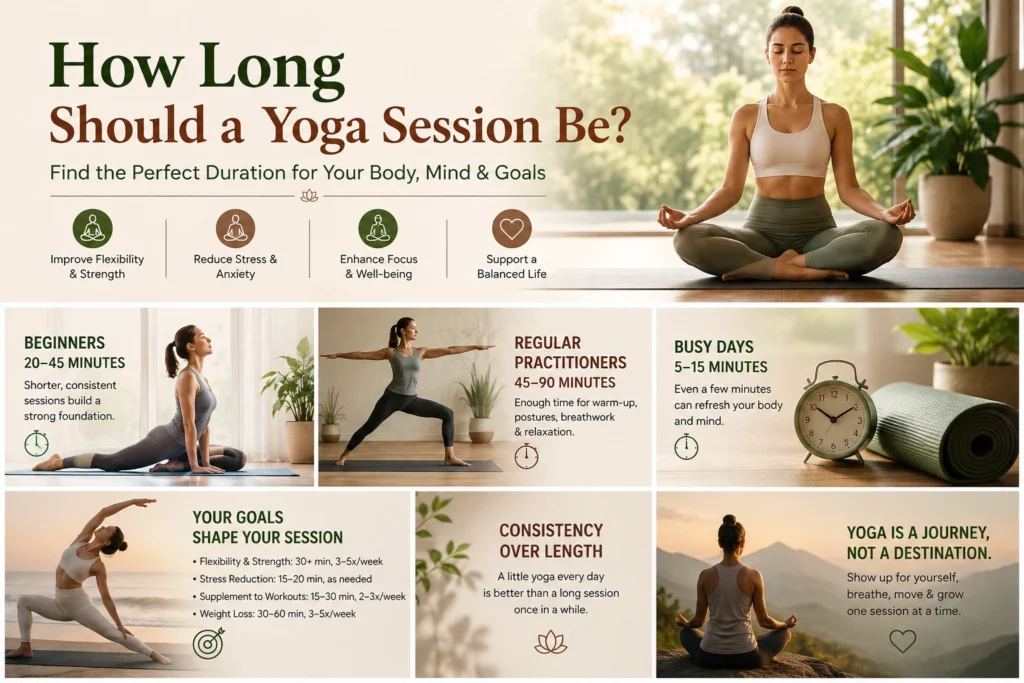
Beginners (20–45 minutes)
If you’re wondering how long should a yoga session be for beginners, shorter and more frequent sessions are usually the best option. A daily 20-minute practice can significantly boost flexibility and strength and reduce stress. A great starting point is three 20–30-minute sessions per week.
Regular Practitioners (45–90 minutes)
A 45 to 60-minute session is standard for many classes, allowing ample time for warm-ups, postures, and relaxation. Longer, 90-minute classes, common in vigorous styles like Ashtanga, offer a more comprehensive and in-depth practice.
Busy Days (5–15 minutes)
Even very short “micro-practices” are beneficial. A 10-minute session focused on stretching or breathwork can provide a quick reset during a lunch break or before bed.
Factors Influencing Session Length
Your yoga goals can help determine the ideal session length:
Improve Flexibility, Strength, and Balance
Aim for 3–5 sessions per week, each lasting at least 30 minutes. Consistent practice is key to gradual progress.
Stress Reduction
Even short, focused sessions can be effective for mental and emotional well-being. Restorative yoga, slow flow, or breathing exercises for 15–20 minutes as often as needed can reduce stress.
Supplementing Other Workouts
If you already have a cardio or strength training routine, 2–3 shorter yoga sessions per week (15–30 minutes) are perfect for improving mobility, balance, and flexibility.
Weight Loss
For more vigorous styles like Vinyasa or power yoga, aim for 3–5 sessions a week, lasting 30 to 60 minutes. Yoga is most effective for weight loss when combined with a balanced diet.
The Perfect Length of a Yoga Class
The majority of yoga classes are between twenty minutes and ninety minutes. Beginners tend to prefer shorter classes. A twenty- or thirty-minute class practised consistently can do wonders for flexibility, strength, and stress management. As confidence grows and the body acclimates to new movements, going up to forty-five minutes or an hour becomes second nature.
For someone who has already practised for a while, a forty-five-minute to hour-long class is very typical. It can provide time for a sufficient warm-up, a series of postures that are challenging to the body, some breathing exercises, and a few relaxation or meditation minutes at the end. In more classical styles such as Ashtanga or Iyengar, class tends to last as much as ninety minutes since poses are held longer and breathing passages between them take more time, allowing the body to delve into every movement.
Yet, length is not the only indicator. Even five to fifteen minutes on the mat can be beneficial on particularly hectic days. A brief series of stretches in the morning, a set of sun salutations at lunch, or ten minutes of diaphragmatic breathing before sleep can invigorate the mind and release tension in the body. Most seasoned practitioners attest that it is best to do a small amount daily rather than wait for the ideal sixty-minute time slot that never materialises.
- Beginners: 20–30 minutes, 3 times a week
- Regular practitioners: 45–60 minutes, most days of the week
- Busy schedules: 5–15 minutes, as often as possible
What Shapes Your Yoga Routine
The duration of your sessions will also depend on your goals. If flexibility and strength are your priorities, it helps to aim for sessions of at least thirty minutes, three to five times a week. When stress reduction is the focus, even shorter practices with restorative poses, slow breathing, or meditation can be deeply effective.
Those who employ yoga as a complement to other exercise, like running or weightlifting, might find it best to do shorter practice periods—fifteen to thirty minutes, two to three times a week. If the goal is weight loss, more intense types of yoga, such as Vinyasa, Power Yoga, or Hot Yoga, should be done three to five times a week, each practice being forty-five to sixty minutes long.
What is more important than all of these statistics, though, is regularity. A shorter session that occurs regularly will be of far greater benefit than a lofty ninety-minute class that you only get to do once every few weeks.
How Often Should I Practise Yoga?
If you are just beginning to practise yoga, two or three times a week is typically sufficient. This will allow your body to acclimatise and get accustomed to the postures without overdoing it. Later, increasing to four or five times a week is best. If you are more advanced, you may find that yoga becomes a virtual daily routine with some days spent doing intense flows and others spent on more restorative and gentle work.
It’s also worth noting that yoga is not about postures only. Even rest days see a few minutes of breathing or meditation as yoga and keep the continuity going.
Recommended Frequency by Level
- Beginners: 2–3 times a week
- Intermediate practitioners: 4–5 times a week
- Advanced practitioners: 5–6 times a week or every day (with varying intensity)
Conclusion
So, how long should a yoga session be? The short response is ‘as frequently as you possibly can while being consistent and gentle with yourself’. For novices, that would perhaps be a few sessions a week. For advanced practitioners, it might be on a daily basis. Whether your practice is ten minutes or ninety, the most critical thing is to show up frequently and tune in to your body.
Yoga is not a place but a path. It is a teaching of patience, presence, and the practice of balance not only in positions but also in life. By integrating yoga into your daily or weekly life in a manner that suits your way of living, you make it more than physical exercise. It turns into a lifestyle, providing strength, flexibility, and inner peace that last longer than on the mat.
For more such article visit Indian Bulletins Yoga!